
How to Specify a Custom Stainless Steel Helical Coil (and Get an Accurate Quote Fast)
If you design tanks, beverage systems, reactors or heat-recovery equipment, sooner or later you will need a coil that no catalog stocks: a specific diameter, a specific length, and the inlet and outlet exactly where your housing needs them. That is what a custom stainless steel helical coil is for.
The fastest way to get the right coil, at the right price, is to send a complete specification the first time. This guide covers what to include and the design rules that keep cost down. It follows the same parameters as our helical coil request for quotation form, so you can use it as a checklist.
Key takeaways |
|---|
Minimum order: Our MOQ is one piece. We quote everything from a single prototype coil to full production runs. Eight spec items: Coil OD, length, pitch or number of turns, tangent length, outlet distance to center, inlet/outlet angle, tube material, and tube OD × wall. Coil diameter: As a rule of thumb, keep the coil diameter at least 10× the tube OD. Tube size: Our standard tubing range is 1/8" OD to 1.25" OD. Tolerance: Standard tolerance is ±0.030". Lead time: When the tube material is in stock, the whole coil order typically ships in about one week. New designs first require a sample for your approval, which takes about two weeks. US and Canada: We quote DDP (Delivered Duty Paid), so delivery and import duties are included in the price. Quality: Our quality management system is ISO 9001:2015 certified. |
What Is a Custom Helical Coil?
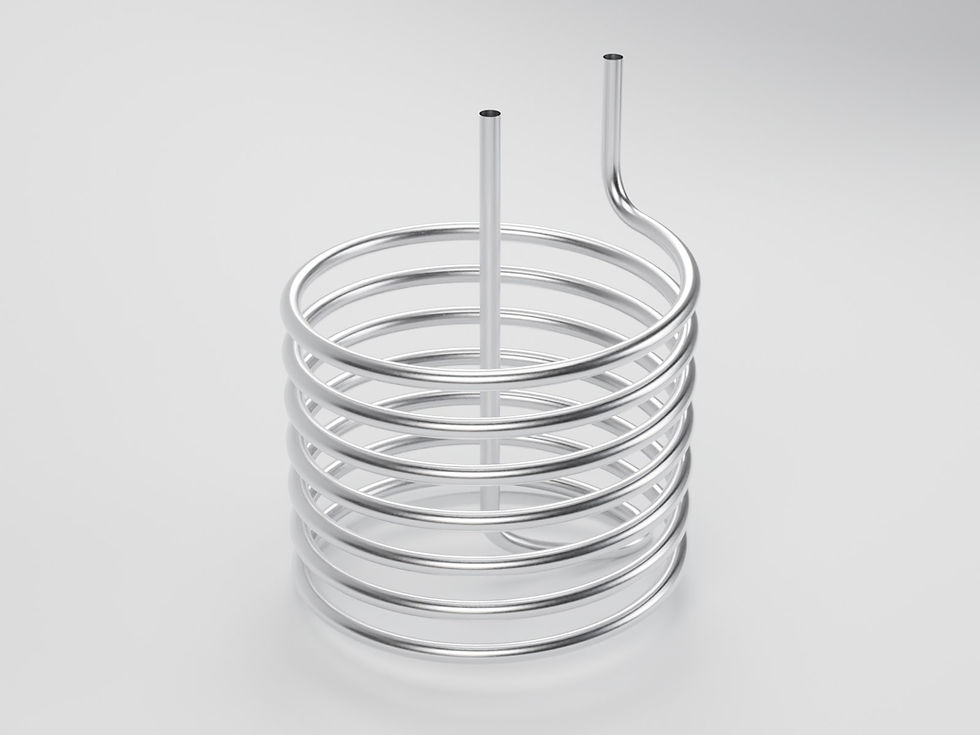
A helical coil is a length of tubing rolled into a helix. Some designs use a double helix, which lets the inlet and outlet sit side by side. Coils are a simple, economical way to add heat-transfer surface inside a tank, vessel, duct or appliance. Hot or cold media flows through the tube while the product outside is heated or cooled.
If your application needs it, Lizheng can form the coil from one continuous length of tube, with no welded joints or intermediate connections along the coil. That includes extra-long and multi-layer coils. Fewer joints mean fewer places where a leak can start, which matters most in sanitary and pressurized service.
One-piece construction is an option you request, not the default for every product, and it costs more than a design with joints. If you need it, say so in your RFQ. You can see typical examples on our helical coil heat exchanger page.
The 8 Things to Include in Your Coil Specification
Our quote form asks for eight items. If you send all of them, we can quote without a round of follow-up questions.

Parameter (symbol) | What to specify |
|---|---|
1. Coil outside diameter (D) | This is the overall outside diameter of the helix. It is usually set by the tank, the vessel opening or the space in your housing, so leave clearance for installation and supports. |
2. Coil length (L) | This is the overall height of the helix, measured along its axis. Together with D and the pitch, it sets how much tube (and so how much heat-transfer surface) the coil holds. |
3. Pitch or number of turns (P) | Give either the pitch (the center-to-center distance between turns) or the total number of turns. A tighter pitch fits more surface into the same length. A looser pitch leaves room for liquid to flow between turns. |
4. Tangent length (T) | The tangent is the straight length of tube at each end, before or after the helix. It is where your fittings, bulkhead connectors or tank penetrations attach. |
5. Outlet distance to center (R) | R is the distance from the outlet to the coil's center line. It decides where the outlet lands relative to the inlet, which matters when both ends have to pass through one lid or flange. |
6. Relative angle between inlet and outlet (Θ) | Θ is the angle between the inlet and the outlet when you look down the coil's axis. If your connections have to line up with existing ports, this number is critical. |
7. Tube material | Name the alloy: for example 304 or 316L stainless steel, copper, or titanium. (See the material section below.) |
8. Tube size: OD × wall thickness | Give the tube outside diameter and wall thickness, for example 0.25" × 0.027" (6.35 mm × 0.7 mm). Tell us your design pressure and temperature too, so we can check the wall thickness against them. |
Also helpful: quantity (prototype or production), the media inside and outside the tube, end connections, any surface-finish requirement, and a sketch or 2D/3D drawing if you have one.
Choosing the Material
304 stainless steel is a common general-purpose choice. An example is our 304 helical coil heat exchanger for indirect water heaters.
316 / 316L stainless steel contains molybdenum, which improves corrosion resistance against many chemicals and chlorides. It is often chosen for beverage, marine and chemical service. Our two-layer jockey box cooling coil is made from 316L as standard.
Other alloys: depending on the project, we also work with 321 stainless, duplex stainless, copper, titanium, carbon steel and Inconel, along with UNS S44660 super ferritic tubing. Browse the full alloy list.
For more on grade selection, see how to choose the right stainless steel for heating and cooling coils. The final choice should be confirmed for your actual process conditions.
Design Rules That Keep Your Coil Affordable
These guidelines come from our tube bending and helical coiling guidelines. Designs that follow them need simpler tooling and usually cost less.
Keep coil diameter at least 10× the tube OD
A coil diameter of at least 10 times the tube outside diameter reduces tube flattening and keeps tooling simple. For example, a 1/4" tube coils comfortably at about 2.5" diameter or larger. A 1/2" tube should be about 5" or larger.
Stay within the standard tube size range
Our standard tubing range is 1/8" OD to 1.25" OD. Check our 304 stainless tube size list and 316L stainless tube size list. Choosing an in-stock size can reduce both fabrication cost and lead time. If your size isn't listed, we can still source it.
Use a standard bend radius on the tangents
When the ends need bends, a center-line radius (CLR) of about 3× the tube OD works without mandrels. A tighter 1× or 2× bend is possible, but it needs more complex tooling and costs more. Use the same CLR for every bend where you can, and leave at least 3× OD of straight tube between bends for clamping.
Don't over-tolerance
Standard tolerance is ±0.030", and large parts are measured in a constrained condition. Every tighter tolerance adds cost. Open up any tolerance your design doesn't truly need.
Check pressure rating early
Allowable pressure depends on the alloy, the tube OD and wall, the temperature, and whether the tube is welded or seamless. Our design pressure table for 304 and 316 tube is a general guide only. Have a qualified engineer confirm the rating for your conditions.
Welded or seamless tube
Our in-stock 304 and 316L tube is welded tube (with a longitudinal seam). Seamless tube is also available.
If the seamless tube you need is in stock, the whole coil order typically ships in about one week. If it has to be sourced, lead time is longer, and we discuss it with you case by case. If your design pressure or industry standard calls for seamless tube, say so in your RFQ.
Single, Nested or Shaped: Picking a Coil Style

Single helical coil. The simplest and most economical option for a tank or vessel.
Nested (multi-layer) helical coil. Two or more helices, one inside another, add surface area in the same footprint. They are common in jockey boxes and beverage coolers.
Flat spiral (pancake) coil. For heating or cooling at the bottom of a vessel, where a cylindrical coil would be the wrong shape.
Rectangular / box coil and zig-zag coil. For square housings, ducts and flat panels.
See the full range on our coil products page.
Quality Checks You Should Ask Any Supplier About
Ask any coil supplier how they verify tube quality and leak tightness. At Lizheng, quality control has two parts:
Process QC: we run routine expansion tests on tube samples. The requirement is no failure at 20% expansion.
Product QC: finished coils are air-tightness tested under test pressure, and no leaking is allowed. Coils can also be supplied hydrostatically tested.
Our quality management system is ISO 9001:2015 certified. If your project needs specific inspection or material documentation, ask us about it when you request a quote.
Lead Time and Samples
When the tube material is in stock, the whole coil order typically ships in about one week. If the material has to be sourced, lead time is longer, and we discuss it with you case by case. Order quantity, coil size and complexity also play a part, so we confirm the lead time in your quote.
New designs first require a sample for your approval, which takes about two weeks. Once the sample is approved, in-stock orders follow the one-week timeline above.
There is no minimum order quantity: we build single prototype coils as well as production runs.
Our North America sales and engineering office in Tampa, Florida works with US and Canadian customers. The coils are made at our factory in Foshan, China.
Orders are quoted DDP (Delivered Duty Paid), so the price we quote already includes delivery and import duties. You don't have to arrange customs clearance yourself.
Need Help With the Design?
Not every project starts with a finished drawing. Our engineering team can take a coil or heat-exchange design from concept to completion.
That includes conceptual schematics, solid modeling, stress analysis, prototyping, and 2D/3D detail drawings. We can also work alongside your in-house engineers. Learn more about our heat exchange coil design services.
FAQ
What is the minimum order quantity for a custom helical coil?
Our MOQ is one piece. We quote everything from a single prototype coil to full production runs.
How small can the coil diameter be?
As a rule of thumb, keep the coil diameter at least 10× the tube OD. Tighter coils may be possible but need special tooling, so send us your drawing.
Are your coils welded, and can I get seamless tube?
These are two separate questions. Joints: if you need it, we can form the coil from one continuous tube with no welded joints along its length, including extra-long and multi-layer coils. This option costs more, so tell us when you request a quote.
Tube: our in-stock 304 and 316L tube is welded (seam-welded) tube. Seamless tube is available too. When the tube is in stock, the whole coil order typically ships in about one week. If it has to be sourced, lead time is longer and we confirm it case by case.
What is the lead time?
When the tube material is in stock, the whole coil order typically ships in about one week. If the material has to be sourced, lead time is longer, and we discuss it with you case by case. New designs first require a sample for your approval, which takes about two weeks.
Do you quote delivered prices to the US and Canada?
Yes. We quote DDP (Delivered Duty Paid), so delivery and import duties are included in the price.
Can you make coils from copper or titanium?
Yes. Besides 304 and 316L stainless, we form coils in copper, titanium and other alloys. See our copper tube coil page.
What information do you need for a quote?
Coil OD, length, pitch or number of turns, tangent length, outlet distance to center, inlet/outlet angle, tube material, and tube OD × wall. Quantity and operating conditions help too.
Get a Quote on Your Custom Helical Coil
Have a drawing, or just the eight dimensions above? Send them through our helical coil request for quotation form. You can also email info@lizhengcoils.com or call our North America office at +1 (929) 888-1829. Every coil is quoted per project, based on material, tube size, dimensions and quantity.




Comments